I took on two commission works this summer. Both are for birthday gifts. One is a tiger in color pencils.

The other is a sunflower in watercolor.

Getting paid to do art is a good feeling. I feel valued.
I took on two commission works this summer. Both are for birthday gifts. One is a tiger in color pencils.
The other is a sunflower in watercolor.
Getting paid to do art is a good feeling. I feel valued.
One thing that lead to me taijiquan was missing two adult teeth.
When I was about 8 year-old, x-ray showed that I was missing two permanent teeth. In the couple years following, I went to the dentist a lot. As I waited in the waiting room, I read and re-read whatever reading material available, which included a set of comic books by the Taiwanese cartoonist Tsai Chih Chung. The most notable among them was "Zhuangzi Speaks: The Music of Nature". The talented Mr. Tsai presented the Zhuangzi's humourous parables in an easy-to-digest format. I was a bit of misfit as a child. It struck a cord with me when Zhuangzi spoke of freeing oneself from rigid value systems, staying true to one's nature, and maneuvering through an ever-shifting and inconstant world. My affinity to Doaist philosophy eventually lead to me Taijiquan, a martial art that drew inspirations from Doaism.
Zhuangzi was a Chinese philosopher in 4th century BC during a period of political upheaval, known as the Warring State period. Zhuangzi's most famous story was probably his dream of being a butterfly, where he questioned human perception of reality.

But my childhood favorite was the story about the useless tree and the useless goose.


The story "The Cook Carved up a Cow" fascinated martial artists for thousands of years.


For anyone who's interested, I have the book in the lobby. Feel free to check it out when you come!
Since we opened in 2014, we have seen close to 700 patients. Out of curiosity, I tallied up their reasons for seeking acupuncture help as indicated on their initial patient intake information. Here are the top 10 reasons why people try acupuncture:
Back Pain is the number one reason by a large margin. With conditions ranging from herniated discs to muscular tension.
Neck and shoulder issues are often intertwined. Sometimes overlapped with back pain or even jaw pain or headache.
Inability to relax seems to be a sweeping issue. In many cased related to headache, weight issue, or even mood swing when attempt to quit smoking.
Many people suffer from condition ranging from chronic migraine to tension headache.
Ranging from Irritable Bowel Syndrome to acid reflux. Some seek to improve their digestive function of wheat or lactose.
Common source of foot pain is Plantar Fasciitis.
People seek relief from conditions ranging from seasonal allergy to chronic sinus condition.
The list goes on and some of the reasons might surprise you. The rest of the tally are as followed:
11. General Aches and Pain (33)
12. Fatigue (29)
13. Gynecological / Reproductive Issue (24)
14. General Wellness (23)
14. Arm Pain (23)
15. Cold / Numb / Tingling in Extremities (22)
16. Jaw / Mouth Pain (17)
16. Sleep Issue (17)
17. Wrist Pain (15)
18. Hand Pain (13)
18. General Joint Pain (13)
18. Blood Pressure (13)
19. Quit Smoking (12)
19. Ankle Pain (12)
19. Dermatological Issue (12)
19. Gland / Hormonal Issue (12)
20. Dizziness / Balance Issue (10)
20. Elbow Pain (10)
21. Cognitive Issue (9)
22. Respiratory Issue (8)
22. Post-Cancer Healing (8)
23. Feeling of Heat (7)
24. Curiosity (6)
25. Post-Surgery Healing (5)
25. Ringing in the Ear (5)
26. Urinary Issue (4)
26. Eye Discomfort (4)
26. Edema (4)
27. Bells Palsy (3)
28. Diabetes (2)
28. Light and Sound Sensitivity (2)
29. Hiccup (1)
29. Facial Rejuvenation (1)
29. Auto-Immune Issue (1)
29. Hearing Issue (1)
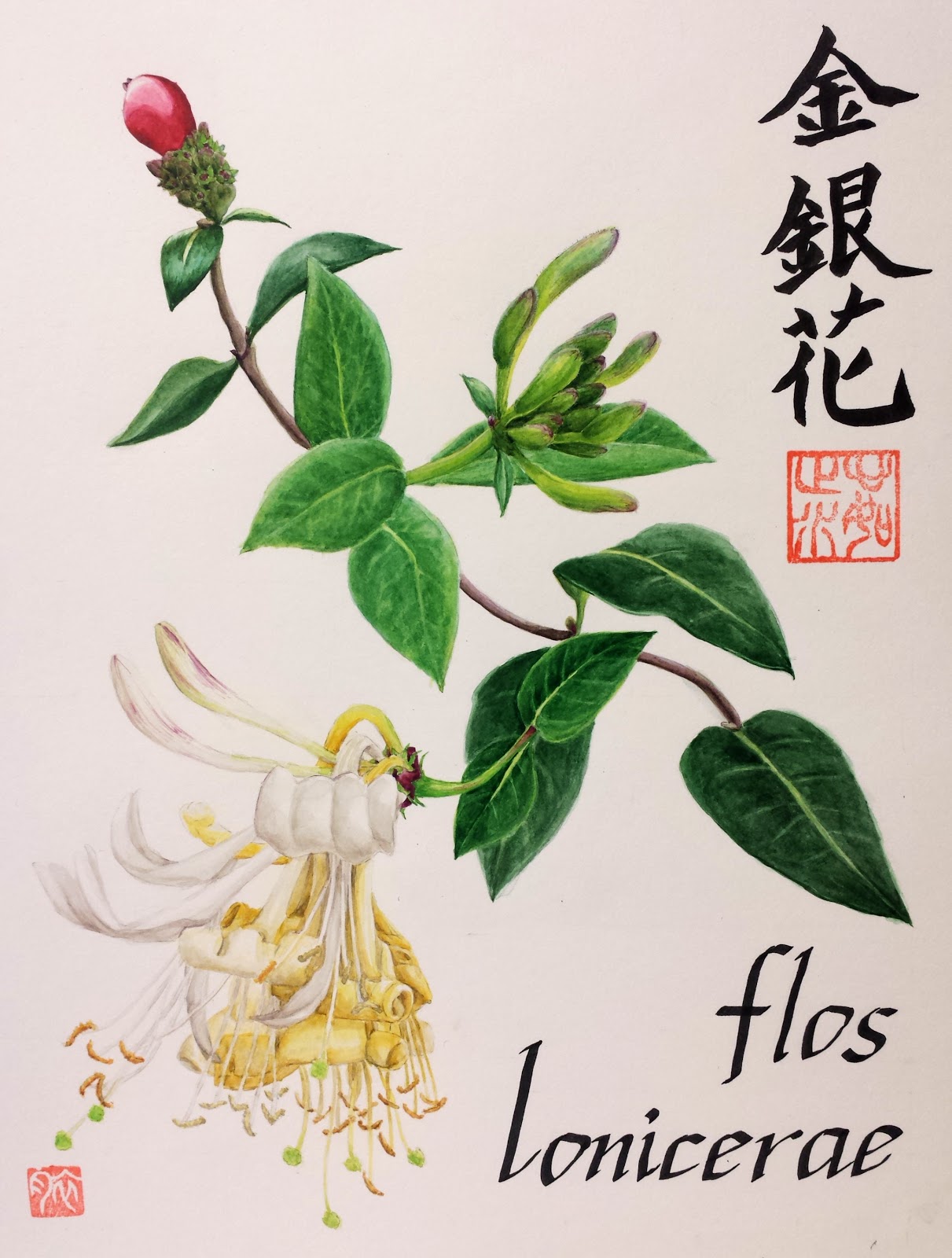
Kevin and I planted 4 different varieties of honeysuckle on the back of the building several years before we started the business.
In hindsight, 2 honeysuckles would have been enough to cover the space. They are incredibly vigorous and would tear down the gutter and swallow the building if left alone.
I have long since lost the variety tags from the nursery. I believe one is an North American non-vining variety and the other three are Lonicera japonica. So when it came to picking out the medicinal variety to paint, I just picked one that fits the Chinese name better - "Gold and Silver Flower".
The composition shows the three stages of the flower, from immature yellow-green (that's when you would picked it for Chinese medicinal use), to showy yellow and white full bloom, ends in dropping all its petals and forming a jewel red fruit.
Since last time I shared the process of wet mounting, I decide to share a bit about how I painted the botanical watercolor.

When I picked the chrysanthemum flowers in the fall, I took some reference pictures. The photo looked fine when I first took it, but later as I tried to draw and paint for it, I found it lacking contrasts and slight blurry, making the process challenging.

Sometimes in the beginning of the year, on a sketchbook I roughed out the basic layout of the painting, including the positions of the Latin botanical name, the Chinese name, and the seals.

On an new sketchbook page with a mechanical pencil, I drew the chrysanthemum with as much as precision as I can, making sure the shapes were well-defined. This step doesn't look like much but I would say it's the most important step.

Once I was happy with it, I put a transparency with grid on top of my pencil drawing, drew a grid on my watercolor paper, and transfer the drawing. I used hot-press paper for its smooth surface, and lighter pencil pressure so I don't etch too much into the paper.

As I transferred, I erased the grid lines as I go. I still looked at the reference photo and making decisions as I transferred, so the final drawing on the watercolor paper was a little different than the pencil drawing.

Looking at the reference photo, I applied the watercolor in layers, mostly with a size 0 brush. I had to make up some details as I go, because the reference photo was a bit flat, especially in the center of the flowers. It was just a big blob of yellow. After adjusting and re-adjusting the shades and tone, at some point I had to decided when to stop fussing over painting.

At this point, I wrote the Latin and Chinese botanical names with the respectively appropriate calligraphic tools.

Stamped on my name seal, the Peaceful Water seal, and call it done! The painting will be hanging in the hallway next to other botanicals. Next time when you come in, feel free to check it out!
This is a quick behind-the-scene look at "Wet-Mounting". The finishing step in Chinese style watercolor.

When paper is soaked then dried, it inevitably buckles and becomes wavy. Usually for western style watercolor, a heavy-weight paper is used and/or the paper is stretched before the painting process commences to minimize buckling. In Chinese style watercolor, stretching is done after the painting is completed. This saves time because I only stretch the painting I wish to display. Two years ago, I did many different versions of "Journey behind the falls" but I only stretched two.

This year, I did a painting of Letchworth State Park. For Chinese style watercolor, very light-weight absorbent paper is used, traditionally made from tree bark and rice straws. After the painting is done (this is version #3), it's placed good-side down on a smooth surface.

I have my tools handy: backing paper (has to be larger than the painting), water-soluble paste and a wide goat-hair brush, a padded putty knife (traditionally a stubby palm broom is used, but I don't have that).

The whole painting is spritzed with water to help the paper relax. After smoothing out the all the bubbles, it's brushed with the paste. Backing paper is then placed on top, and pushed down with the padded putty knife, assuring good adhesion.

Paste is then applied to the edges of the backing paper. The whole thing is carefully peeled off and stretched good-side up on a mounting board to dry. Once it's dried, it can be remove from the mounting board with an utility knife.
Root of the reliable balloon flowers (桔梗 Jie Geng) is used in Chinese medicine. It was one of the first Chinese medicinal plants that I've acquired. I bought one from The Home Depot three years back and finally got around to painting it this year. Here is a comparison of the reference photo and the painting.


Saffron is usually known as the most expensive spice by weight, or a major ingredient in paella. But it is also used in Chinese herbal medicine. It's called Xi Hong Hua 西紅花(western red flower) or Zang Hong Hua 藏紅花 (Tibetan red flower), used when stronger effects are needed in place of the common safflower (紅花 Hong Hua).
I put in twenty bulbs last year (they were available at Lowes; i didn't even need to source them online) and would highly recommend growing saffron to anyone. Here are my reasons.

They are very cheerful. It's surprising to see flowers blooming in November. Lots of people commented on them. So it also works as a conversation starter.
They are very easy to grow. If you have them in the ground by September, they will flower on first year. They multiply readily. I harvest more than double amount of saffron this year.
Not to mention that they are a high-value crop. You would be expecting to pay $15-20 at the supermarket for a tiny envelope of it. The fresh saffron has a much stronger fragrance. I can't stop sniffing the saffron while they sat on my desk.
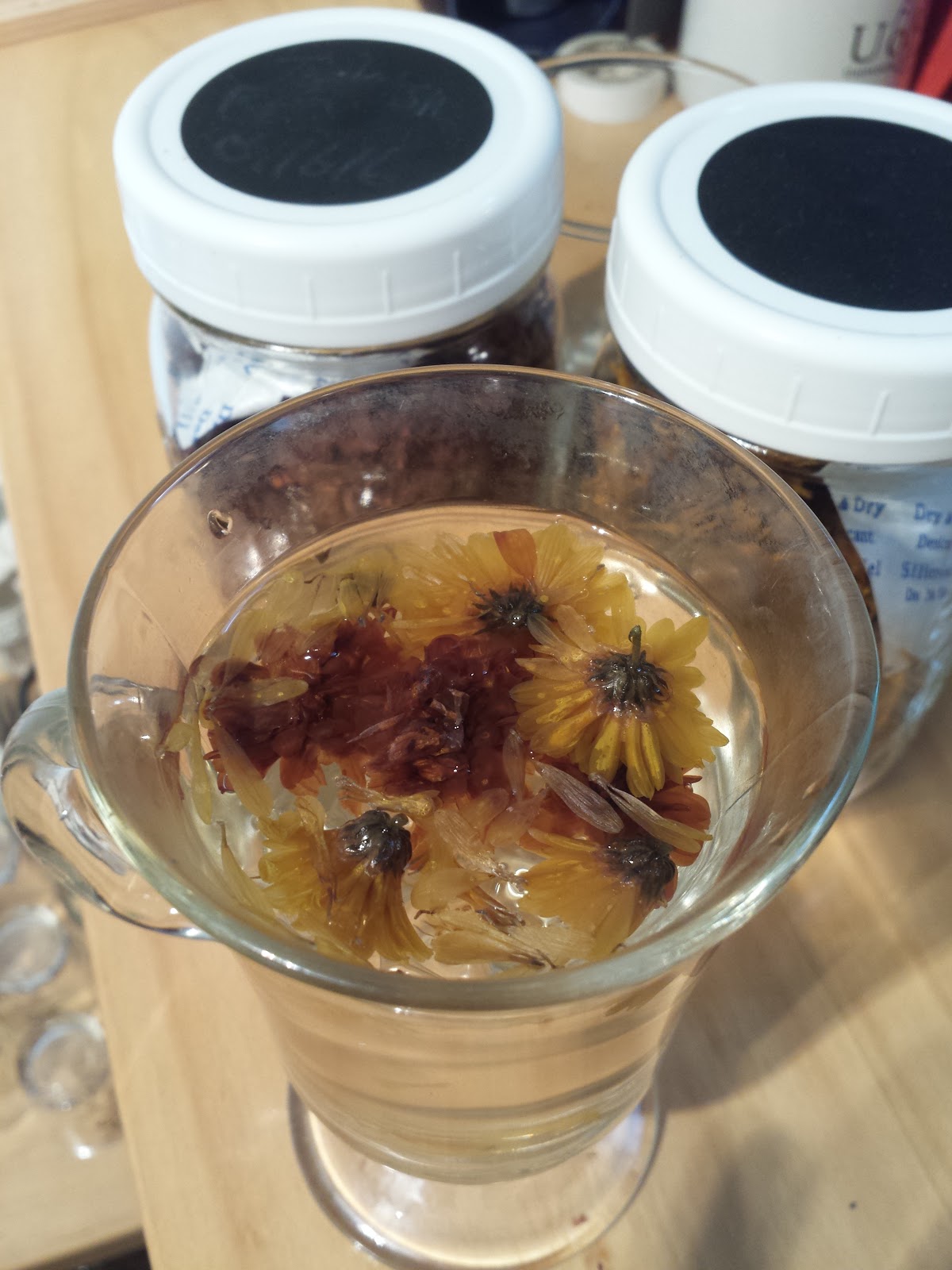
Chrysanthemum (菊花 Ju Hua) is a common Chinese medicinal herb, usually steeped into a beverage and slightly sweetened. Unlike most herbs, chrysanthemum actually TASTES GOOD. I served chilled honeyed chrysanthemum tea at our grand opening party couple years back. Some people actually asked for the recipe. You can buy tightly-packed dry chrysanthemum at the Chinese supermarket but it is quite easy to grow your own. And here's how.

In late August, when the garden centers start to put the chrysanthemum out, buy a couple. They are cheap. People use them like disposable flowers but if you plant them, they will come back year after year. Plant them as soon as possible in full sun. The more time they have be become established before winter, the better chance they have. Ideally, they should be in the ground by the first week of September.
Do nothing for a while. Wait for them to die back with when the hard frosts and DON'T cut them back. Around Thanksgiving, cover them with 2-3" of mulch.

Pull back the mulch in March and check for new growth. They might be a bit tender at this time and can die back with spring frost. But by April they should be back. Now you can cut last year's dead branches, spread the mulch and fertilize.
Some people pinch their mums, but I don't and there are still plenty of flowers. When flowers are in full bloom, it's harvest time. They are so prolific. You can pick for half an hour and not put a dent in the display.

Clean the flowers by soaking them in water with a couple drops for vinegar, drain and rinse. Then dry them in the dehydrator or in a oven at the lowest setting.

Store in jar. Traditionally, it's the white and yellow chrysanthemum that are used in tea. I've tried red and purple too. They do taste different and the infusion is slightly darker.

In the spring I told my parents that I was planting some onions in my garden. My dad said, "Onions are so cheap to buy. Why don't you grow some high-value specialty crop instead?"
So this autumn, I'm trying my hand at growing American Ginseng. The seeds are from Johnny's Selected Seeds and had been stratified and ready to go. I promptly put them in the ground. We'll see if they come up next year.

I grew some Hungarian Blue Breadseed poppies by our front door. Poppies flowered in early summer. The droopy flower buds gradually straightened up and bloomed. The flowers lasted only a couple days then dropped all petals, leaving the seed pods. The seed pods nodded in the wind for a while and gradually dried up. Seed pods were picked and the seeds were harvested. The empty seed casings are used in Chinese herbal medicine for chronic cough, diarrhea and pain.

In this watercolor painting, I combined the 3 stages of the flower development in the composition. I chose to paint the poppy at the height of its prettiness and not when it's browned and shriveld, ready to be used for medicine. I suppose my choice is sentimental and not scientific. But I like pretty. So there you have it.
Also debuting the negative-carved stone chop with the Peaceful Water motto 心如止水 (Heart liken to still water). The meaning behind Peaceful Water.

I've planted the seedlings I started this spring. Hyacinths beans (bai bien dou), and Job's Tears (yi yi ren) are annuals. I planted them in containers, with some Pinks (qu mai) thrown in as fillers.

Tree Peony (mu dan) was moved to the corner, with newly planted Astragalus (huang qi), Licorice (gan cao), and Codonopsis (dang shen). All three new herbs are perennials and are harvested for their roots 3-5 years after planting.

Both Agastache rugosa (huo xiang) and Agastache foeniculum are planted in the crescent-shaped bed beside Coburn Chiropratic entrance. With some western herbs, St. John's Wort and Yarrow, to keep them company.

I put down some Bei Mu 貝母 fritillaria last fall. I couldn't find the commonly used medicinal varieties: 川貝母 Fritillaria cirrohosa or 浙貝母 Fritillaria thunbergii. I just put down the common garden center variety Fritillaria meleagris, sometimes called Checkered Lily. They've emerged just a little bit after the daffodils. I'm continuing my efforts on realistic botanical drawings.

Preparatory sketch then copy to a a watercolor pad.

After coloring and calligraphy.

百合 Bai He or lily bulbs, commonly used varieties are Lilium brownii, Lilium pumilium or Lilium lancifolium. Lilium lancifolium is Tiger Lily. When I saw them at Lowes, I grabbed myself a bag. When I was in Taiwan, I had eaten fresh lily bulb stir-fried with beef. It was very good. Taste was like a cross between potato and water chestnut.

赤芍 Chi Shao (red peony) and 白芍 Bai Shao (white peony). 芍藥 Shao Yao is herbaceous peony. Since we've already have two 牡丹 Mu Dan (tree peony), it's time to plant more herbaceous peonies. I bought "Shirley Temple" for white and "Karl Rosenfeild" for red.

In February I set up some lights in my basement and bought some heat mats. I started some herbs along side vegetables and flowers. I tried to find varieties specifically used for traditional Chinese medicine. However some of seeds I started are just relatives to the the medicinal varieties.
For example, after finding out 瞿麥 Qu Mai is a Pinks, more specifically Dianthus serperbus or Dianthus chinesis, I went into Lowes looking for Pinks seeds. Maiden Pinks (Dianthus deltoides), was all I can find. So that what I grew.

I also started 藿香 Huo Xiang. The medicinal varieties used are usually Pogostemon cablin (Patchouli) or Agastache rugosa, available here as Korean Hyssop. I bought Agastache foeniculum (Anise Hyssop) along with Agastache rugosa, so I'm starting both.

Some seeds really took off. 薏苡仁 Yi Yi Ren or Job's Tear has a 100% super fast germination and is currently growing bigger than the space I have.

Some seeds did not germinate well. I put 2-3 seeds per cell and only 1 seed germinated for 甘草 Gan Cao (Licorice).

黃耆 Huang Qi (Astragulus or Chinese Milk Vetch) has pretty good germinate rate is growing steadily.

黨參 Dang Shen (Codonopsis or Poor Man's Ginseng) germinated so slowly, I nearly gave up on it.

白扁豆 Bai Bian Dou Hyancinth Beans are showing a lot potential. The germination was fast and 100%. It grew so fast I already had to up-pot it. Instruction on the package said to start indoor, but conventional garden wisdom says beans hates to be transplanted and should be direct-sown. We'll see how these turn out.

In the future I wish to paint more Chinese medicinal herbs. To do so, I want to grow more herbs and observe them.
Earlier in the year when I was purchasing seeds for my vegetable & flower garden, I notice that the seed companies also carry a lot of herbs seeds used in traditional Chinese medicine. Some were even sold as flowers seeds. I decided to started some Chinese medicinal herbs from seeds this growing season.

