I took on two commission works this summer. Both are for birthday gifts. One is a tiger in color pencils.

The other is a sunflower in watercolor.

Getting paid to do art is a good feeling. I feel valued.
I took on two commission works this summer. Both are for birthday gifts. One is a tiger in color pencils.
The other is a sunflower in watercolor.
Getting paid to do art is a good feeling. I feel valued.
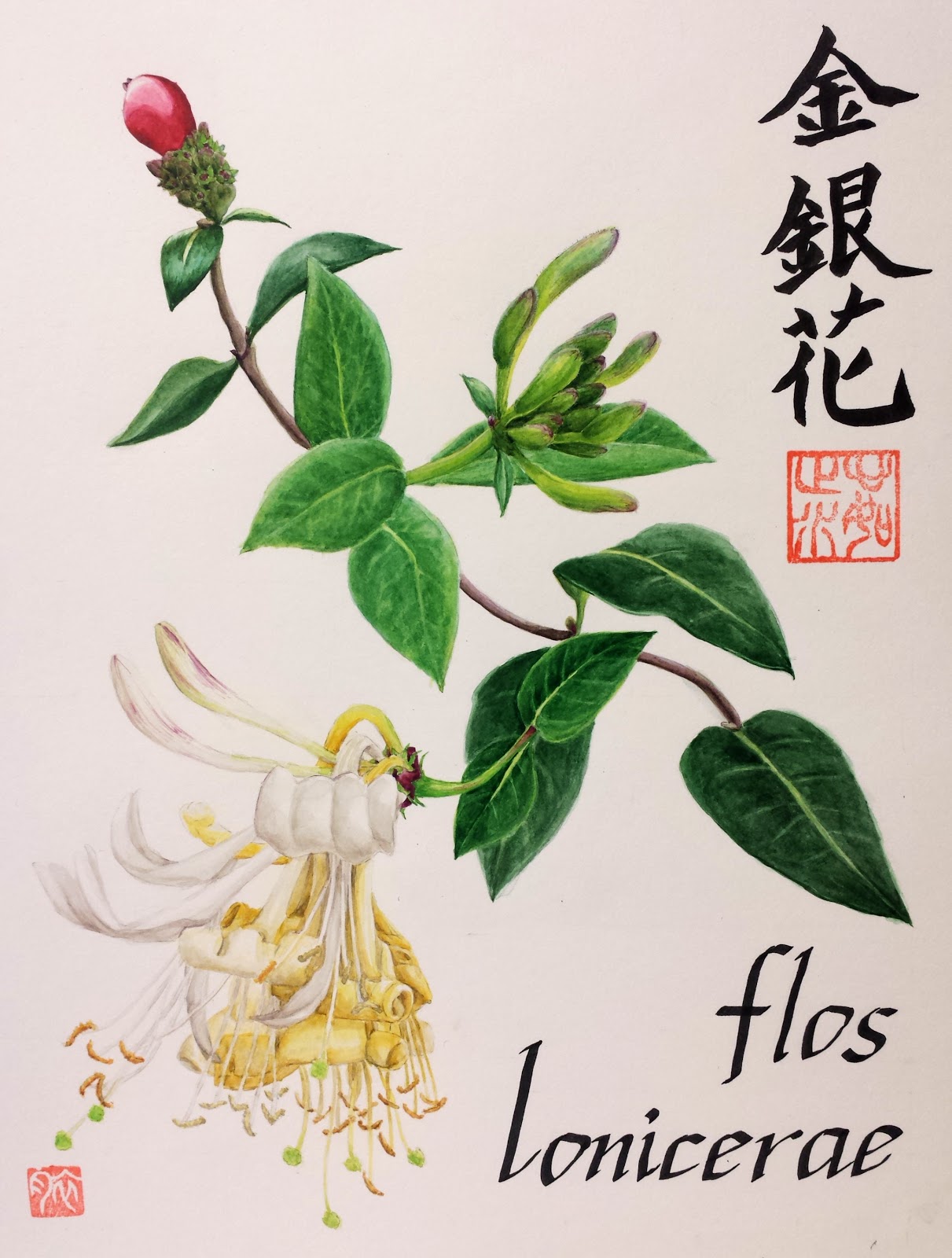
Kevin and I planted 4 different varieties of honeysuckle on the back of the building several years before we started the business.
In hindsight, 2 honeysuckles would have been enough to cover the space. They are incredibly vigorous and would tear down the gutter and swallow the building if left alone.
I have long since lost the variety tags from the nursery. I believe one is an North American non-vining variety and the other three are Lonicera japonica. So when it came to picking out the medicinal variety to paint, I just picked one that fits the Chinese name better - "Gold and Silver Flower".
The composition shows the three stages of the flower, from immature yellow-green (that's when you would picked it for Chinese medicinal use), to showy yellow and white full bloom, ends in dropping all its petals and forming a jewel red fruit.
Since last time I shared the process of wet mounting, I decide to share a bit about how I painted the botanical watercolor.

When I picked the chrysanthemum flowers in the fall, I took some reference pictures. The photo looked fine when I first took it, but later as I tried to draw and paint for it, I found it lacking contrasts and slight blurry, making the process challenging.

Sometimes in the beginning of the year, on a sketchbook I roughed out the basic layout of the painting, including the positions of the Latin botanical name, the Chinese name, and the seals.

On an new sketchbook page with a mechanical pencil, I drew the chrysanthemum with as much as precision as I can, making sure the shapes were well-defined. This step doesn't look like much but I would say it's the most important step.

Once I was happy with it, I put a transparency with grid on top of my pencil drawing, drew a grid on my watercolor paper, and transfer the drawing. I used hot-press paper for its smooth surface, and lighter pencil pressure so I don't etch too much into the paper.

As I transferred, I erased the grid lines as I go. I still looked at the reference photo and making decisions as I transferred, so the final drawing on the watercolor paper was a little different than the pencil drawing.

Looking at the reference photo, I applied the watercolor in layers, mostly with a size 0 brush. I had to make up some details as I go, because the reference photo was a bit flat, especially in the center of the flowers. It was just a big blob of yellow. After adjusting and re-adjusting the shades and tone, at some point I had to decided when to stop fussing over painting.

At this point, I wrote the Latin and Chinese botanical names with the respectively appropriate calligraphic tools.

Stamped on my name seal, the Peaceful Water seal, and call it done! The painting will be hanging in the hallway next to other botanicals. Next time when you come in, feel free to check it out!
This is a quick behind-the-scene look at "Wet-Mounting". The finishing step in Chinese style watercolor.

When paper is soaked then dried, it inevitably buckles and becomes wavy. Usually for western style watercolor, a heavy-weight paper is used and/or the paper is stretched before the painting process commences to minimize buckling. In Chinese style watercolor, stretching is done after the painting is completed. This saves time because I only stretch the painting I wish to display. Two years ago, I did many different versions of "Journey behind the falls" but I only stretched two.

This year, I did a painting of Letchworth State Park. For Chinese style watercolor, very light-weight absorbent paper is used, traditionally made from tree bark and rice straws. After the painting is done (this is version #3), it's placed good-side down on a smooth surface.

I have my tools handy: backing paper (has to be larger than the painting), water-soluble paste and a wide goat-hair brush, a padded putty knife (traditionally a stubby palm broom is used, but I don't have that).

The whole painting is spritzed with water to help the paper relax. After smoothing out the all the bubbles, it's brushed with the paste. Backing paper is then placed on top, and pushed down with the padded putty knife, assuring good adhesion.

Paste is then applied to the edges of the backing paper. The whole thing is carefully peeled off and stretched good-side up on a mounting board to dry. Once it's dried, it can be remove from the mounting board with an utility knife.
Root of the reliable balloon flowers (桔梗 Jie Geng) is used in Chinese medicine. It was one of the first Chinese medicinal plants that I've acquired. I bought one from The Home Depot three years back and finally got around to painting it this year. Here is a comparison of the reference photo and the painting.


I grew some Hungarian Blue Breadseed poppies by our front door. Poppies flowered in early summer. The droopy flower buds gradually straightened up and bloomed. The flowers lasted only a couple days then dropped all petals, leaving the seed pods. The seed pods nodded in the wind for a while and gradually dried up. Seed pods were picked and the seeds were harvested. The empty seed casings are used in Chinese herbal medicine for chronic cough, diarrhea and pain.

In this watercolor painting, I combined the 3 stages of the flower development in the composition. I chose to paint the poppy at the height of its prettiness and not when it's browned and shriveld, ready to be used for medicine. I suppose my choice is sentimental and not scientific. But I like pretty. So there you have it.
Also debuting the negative-carved stone chop with the Peaceful Water motto 心如止水 (Heart liken to still water). The meaning behind Peaceful Water.

I put down some Bei Mu 貝母 fritillaria last fall. I couldn't find the commonly used medicinal varieties: 川貝母 Fritillaria cirrohosa or 浙貝母 Fritillaria thunbergii. I just put down the common garden center variety Fritillaria meleagris, sometimes called Checkered Lily. They've emerged just a little bit after the daffodils. I'm continuing my efforts on realistic botanical drawings.

Preparatory sketch then copy to a a watercolor pad.

After coloring and calligraphy.
