Wednesday, December 14, 2016

Balloon Flower 桔梗 Jie Geng

Root of the reliable balloon flowers (桔梗 Jie Geng) is used in Chinese medicine. It was one of the first Chinese medicinal plants that I've acquired. I bought one from The Home Depot three years back and finally got around to painting it this year. Here is a comparison of the reference photo and the painting.

Tuesday, November 1, 2016

Saffron: High-Value Low-Hassle

Saffron is usually known as the most expensive spice by weight, or a major ingredient in paella. But it is also used in Chinese herbal medicine. It's called Xi Hong Hua 西紅花(western red flower) or Zang Hong Hua 藏紅花 (Tibetan red flower), used when stronger effects are needed in place of the common safflower (紅花 Hong Hua).

I put in twenty bulbs last year (they were available at Lowes; i didn't even need to source them online) and would highly recommend growing saffron to anyone. Here are my reasons.

They are very cheerful. It's surprising to see flowers blooming in November. Lots of people commented on them. So it also works as a conversation starter.

They are very easy to grow. If you have them in the ground by September, they will flower on first year. They multiply readily. I harvest more than double amount of saffron this year.

Not to mention that they are a high-value crop. You would be expecting to pay $15-20 at the supermarket for a tiny envelope of it. The fresh saffron has a much stronger fragrance. I can't stop sniffing the saffron while they sat on my desk.

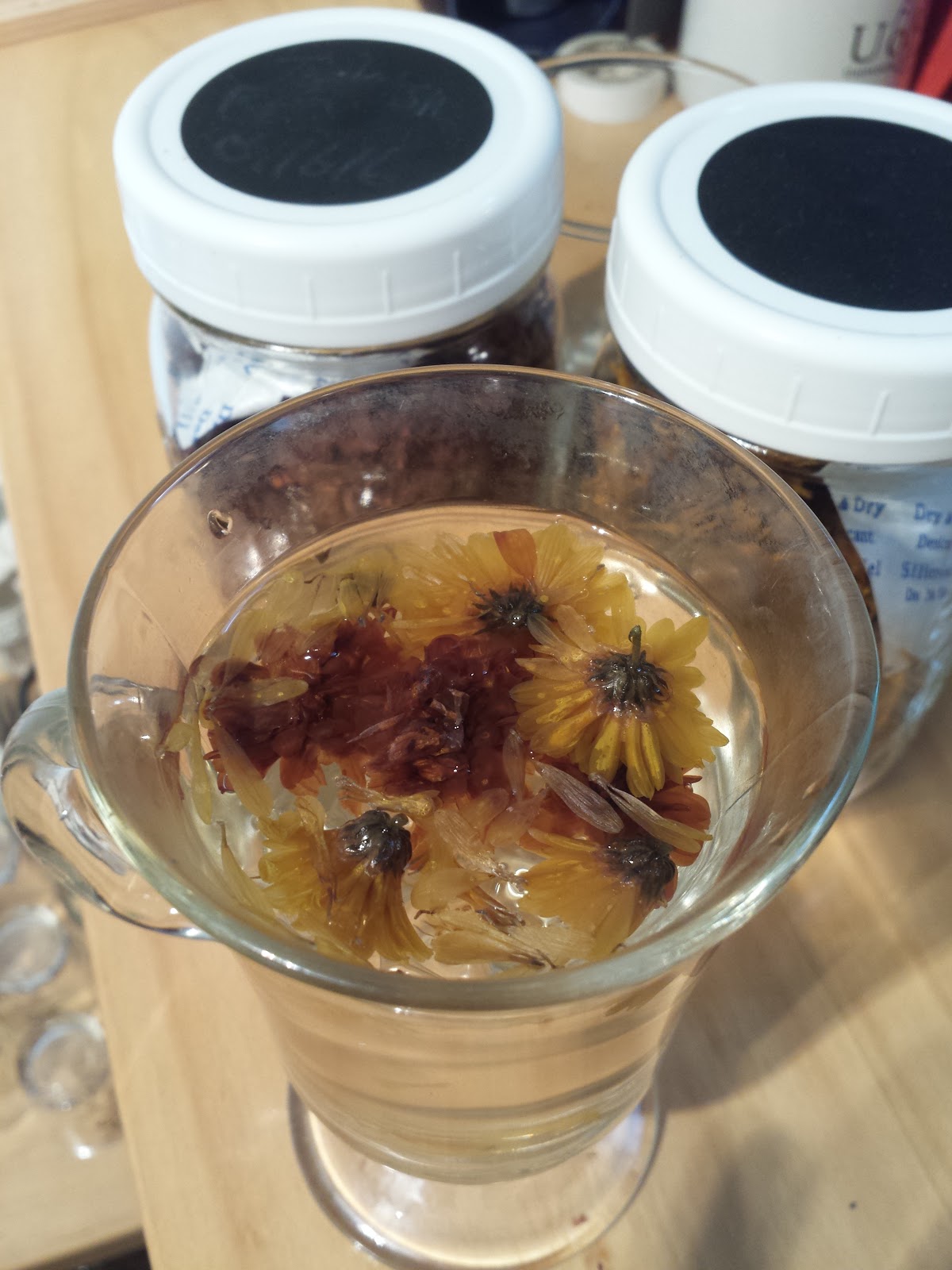
Grow Your Own Chrysanthemum Tea!

Chrysanthemum (菊花 Ju Hua) is a common Chinese medicinal herb, usually steeped into a beverage and slightly sweetened. Unlike most herbs, chrysanthemum actually TASTES GOOD. I served chilled honeyed chrysanthemum tea at our grand opening party couple years back. Some people actually asked for the recipe. You can buy tightly-packed dry chrysanthemum at the Chinese supermarket but it is quite easy to grow your own. And here's how.

In late August, when the garden centers start to put the chrysanthemum out, buy a couple. They are cheap. People use them like disposable flowers but if you plant them, they will come back year after year. Plant them as soon as possible in full sun. The more time they have be become established before winter, the better chance they have. Ideally, they should be in the ground by the first week of September.

Do nothing for a while. Wait for them to die back with when the hard frosts and DON'T cut them back. Around Thanksgiving, cover them with 2-3" of mulch.

Pull back the mulch in March and check for new growth. They might be a bit tender at this time and can die back with spring frost. But by April they should be back. Now you can cut last year's dead branches, spread the mulch and fertilize.

Some people pinch their mums, but I don't and there are still plenty of flowers. When flowers are in full bloom, it's harvest time. They are so prolific. You can pick for half an hour and not put a dent in the display.

Clean the flowers by soaking them in water with a couple drops for vinegar, drain and rinse. Then dry them in the dehydrator or in a oven at the lowest setting.

Store in jar. Traditionally, it's the white and yellow chrysanthemum that are used in tea. I've tried red and purple too. They do taste different and the infusion is slightly darker.

Thursday, October 13, 2016

Fifty American Ginseng Seeds

In the spring I told my parents that I was planting some onions in my garden. My dad said, "Onions are so cheap to buy. Why don't you grow some high-value specialty crop instead?"

So this autumn, I'm trying my hand at growing American Ginseng. The seeds are from Johnny's Selected Seeds and had been stratified and ready to go. I promptly put them in the ground. We'll see if they come up next year.

Tuesday, September 6, 2016

Poppy Seed Casing 罌粟殼 Ying Su Ke

I grew some Hungarian Blue Breadseed poppies by our front door. Poppies flowered in early summer. The droopy flower buds gradually straightened up and bloomed. The flowers lasted only a couple days then dropped all petals, leaving the seed pods. The seed pods nodded in the wind for a while and gradually dried up. Seed pods were picked and the seeds were harvested. The empty seed casings are used in Chinese herbal medicine for chronic cough, diarrhea and pain.

In this watercolor painting, I combined the 3 stages of the flower development in the composition. I chose to paint the poppy at the height of its prettiness and not when it's browned and shriveld, ready to be used for medicine. I suppose my choice is sentimental and not scientific. But I like pretty. So there you have it.

Also debuting the negative-carved stone chop with the Peaceful Water motto 心如止水 (Heart liken to still water). The meaning behind Peaceful Water.

Monday, May 23, 2016

New medicinal herbs in our garden

I've planted the seedlings I started this spring. Hyacinths beans (bai bien dou), and Job's Tears (yi yi ren) are annuals. I planted them in containers, with some Pinks (qu mai) thrown in as fillers.

Tree Peony (mu dan) was moved to the corner, with newly planted Astragalus (huang qi), Licorice (gan cao), and Codonopsis (dang shen). All three new herbs are perennials and are harvested for their roots 3-5 years after planting.

Both Agastache rugosa (huo xiang) and Agastache foeniculum are planted in the crescent-shaped bed beside Coburn Chiropratic entrance. With some western herbs, St. John's Wort and Yarrow, to keep them company.

Fritillaria 貝母

I put down some Bei Mu 貝母 fritillaria last fall. I couldn't find the commonly used medicinal varieties: 川貝母 Fritillaria cirrohosa or 浙貝母 Fritillaria thunbergii. I just put down the common garden center variety Fritillaria meleagris, sometimes called Checkered Lily. They've emerged just a little bit after the daffodils. I'm continuing my efforts on realistic botanical drawings.

Preparatory sketch then copy to a a watercolor pad.

After coloring and calligraphy.