Saturday, November 21, 2015

Remove Physical and Mental Stress with Breathing

On October 24, Kevin and I attended the Breathing Master Class with Vladimir Vasiliev at the Systema HQ in Toronto. Many of the exercises focus on removing fear from the body and psyche. I have never been in a fight, nor do I ever plan to. Physical struggles for me are wrestling laundry basket up and down the stairs or battling weeds my garden. Even though the exercises were put in the context of combat and physical confrontation, I found myself relating to the work from the perspective of day-to-day life.

Calm the Mind

The first exercise we practiced was “light breathing”. We started with a light inhale, feeling the sensation of air entering the nose. Then gradually we extended the focus to the whole body. The light breathing gathers the mind through physical sensation and action, rather than thinking or imagining. There are times I feel anxious and restless with thousands incomplete thoughts swarming in my head. I cannot think to myself “Focus!”, because that would be adding another thought to the bubbling cauldron of thoughts. But by feeling my own breath, I can center myself in my physical being and ground myself in the here and now.

Awareness & Recovery

Often we have unnecessary tension in the body because we didn't notice it. In one of the exercise we were instructed to sit or lay in awkward postures holding our breath, notice the discomfort that built up in the body, then use breathing to remove it. If the stress on the body is acknowledged and dealt with at the level of “discomfort”, it will not have the chance to accumulate and develop into something worse. At the workshop we learned to constantly and quickly evaluate the internal state of the body and recover fully and honestly before any stress accumulate.

Emotional Cleansing

Breath is the bridge between the physical and the psychological. State of mind effects the way we breath and vice versa. When emotions becomes more intense (e.g. from fear, anger, grief, etc.), breathing becomes compromised. When there's not enough oxygen, body becomes tense. When the body becomes tense, it's harder to breath. Then we tend to become more emotional. On top of that, physical discomforts (e.g. pain, fatigue, tension, etc.) often negatively effect the emotional state, feeding the vicious cycle. At the workshop, we practiced breathing under the effect of physical and emotional challenges. Instead of letting negative emotions surge and swell, we treat it the same way as physical stress and remove it with breathing.

Breath work is healing both for the body and the mind. We now practice these exercises and more at our weekly Breathing for Health classes. If you would like to see what breathing practices can do for you, please join us every Monday & Thursday at 4:30 pm.

Friday, August 21, 2015

Chinese Medicinal Herbs in Your Garden

I started collecting plants used in Chinese herbal medicine. Some I planted at home, some around our office. Many of these plants are very ornamental and can be found at local garden centers.

Peony.

Balloon flowers.

Honeysuckle.

Lily turf.

Poppy.

Chrysanthemum.

Some plants are more specialized I have to order them on-line.

Goji berries.

Mountian yam.

And some planted themselves in my garden without permission.

Dandelion and plantain.

Do you have Chinese medicinal herbs in your garden?

Tuesday, April 28, 2015

The Meaning Behind Peaceful Water

The meanings behind our name and logo came up in conversations a couple of times. I would like to offer some explanations.

When we first brainstormed for a business name, we thought that we would like the name to have something to do with water. The Buffalo area has a lot of connections with water, being situated on the Great Lakes, at close proximity to Niagara Falls, as well as historically developed around the construction of the Erie Canal. Finally we choose the name “Peaceful Water” in English and “止水” in Chinese. We then designed the logo around the Chinese characters.

"止水" can also be translated as “still water” or “calm water”, and is meant to evoke a commonly used phrase “心如止水” or “heart resembles peaceful water”. There are two slightly different meanings associated with the phrase.

First is that a heart at peace can reflect clearly and without distortion. This meaning came from the philosopher 莊周 Zhuag Zhou in 3rd Century BC:

"人莫鑑於流水,而鑑於止水,唯止能止眾止。"

People cannot see their reflections in running water, but they can see their reflections in still water. Only through stillness in yourself can you bring the multitudes to a point of stillness.


Second meaning is that a heart at peace can remain undisturbed in a face of turmoil and challenges. This meaning came from the poet 白居易 Bai Juyi's eulogy for his friend, written in the 9th Century AD:

浩浩世途,是非同軌;齒牙相軋,波瀾四起。

公獨何人,心如止水;風雨如晦,雞鳴不已。"

On the grand path of this world, the right and the wrong ran on the same track; Conflicting like teeth grinding against each other, like waves crashing from all sides.

How could you alone, sir, have your heart remained still like peaceful water; When the wind and rain obscured the light, when the flock croaked incessantly?

Monday, November 3, 2014

Party Recipes Roundup

Back in September, we had our Opening Party, celebrating being in business for almost a year.  It was great party, many people showed up to wish us well, including family, clients, students, and other local businesses.  I don't have any pictures of party because I was very busy that night.  I prepared a lot of food for the party and some people had asked for the recipes  So here is a roundup of party recipes!


Chipotle and Rosemary Roasted Nuts


This is an Ina Garten recipes from Food Network Magazine, December 2011 Issue.  I used peanuts in place of pecans, apple cider in place of orange juice.  Click on the image to see the recipe.

Souffle Cheesecake

I got the recipe from Just One Cookbook blog.  See the original recipe here.  I put the batter in foil muffin cup and reduce the baking time to 45 minutes.

Cinnamon Sweet Potato Pastry

This recipe is adapted from the Chinese translation of Okashi Daihyakka II published by the NHK (Japanese Broadcasting Company).  You can click on the image to see the original recipe.  Here is what I did:

Ingredients (makes 12)

Filling:
Sweet Potato ... 300 g (make sure you use the yellow-flesh, purple-skin variety from Asian market.  The orange-flesh sweet potato from regular supermarket has too much moisture for this recipe)
Butter ... 20 g
Egg yolk ... 1
Sugar ... 40 g
Cinnamon ... 1 tsp

Pastry:
Egg white ... 1
Sugar ... 40 g
Pastry flour ... 110 g
Baking powder ... 1/3 tsp
Cinnamon ... 1 tsp

Finishing:
Egg yolk ... 1
Mirin (Japanese sweet cooking wine) ... 1 tsp
Black Sesame

Step 1  Make the filling
Peel, cut and steam the sweet potato til soft.  Add butter, yolk, sugar and cinnamon while hot and mash it into a smooth paste.  Divide into 6 balls.  Refrigerate to chill.

Step 2  Make the pastry
Mix flour with baking powder, put aside.  Mix sugar in egg white til dissolved, add flour mixture, mix til smooth and pliable.  You might need to add a little water  as you go.  Divide into 6 balls.

Step 3  Assemble
Roll out the pastry, wrap around the filling. Roll it into an oblong with pointy ends, like a football.  Cut it in half with a sharp knife.  Beat egg yolk with mirin and brush the cut side with it.  Sprinkle sesame on top.

Step 4  Bake
Bake in a preheated 350 degree oven for 10 minute.  Cool on the rack.

Chrysanthemum Honey Tea

Chrysanthemum is delicious and deserving its own dedicated post.  You can grown it or buy it at Chinese market or herb store.

Ingredients:

Chrysanthemum
Water
Honey

Steep chrysanthemum flowers in boiling water for 5-10 minutes, remove the flower, add honey to taste. I would use about 2-3 flower per mug.  Drink hot in winter, or make a pitcher and chill in the fridge for summer.

Monday, October 27, 2014

Notes from the Workshop: Breathing for Health - Flexibility & Mobility

We had our first Breathing for Health workshop on October 22.  The topic was "Flexibility & Mobility".  I would like to share a couple notes from the evening.

RELAXING INSTEAD OF STRETCHING
We hold unnecessary tension in our joints and muscles, sometimes unconsciously.  By relaxing and letting go the tension, we can gain flexibility without holding a stretch.  At the workshop, we combined breathing and rhythmic, repetitive movements.  Each time the breath changed (inhale to exhale, exhale to inhale), the movement changed as well.  Artificially taking "deep breath" often causes its own type of tension.  Instead, the breathing pattern should be casual.  The breath should not be held and there should be no pause in the movement.   Sometimes, we can tap the tense spots with our fingers, reminding the area to release.

ONE THING AT A TIME
Often when we were taught a stretch, we were given a goal (e.g. touch you toe).  Then we contort the body to achieve the perceived desired shape.  But in order to obtain "the goal", we move multiple parts of the body (e.g.  round the spine, turn the shoulder, crank the neck), reducing the effectiveness of the stretch, or worse, creating new tension or injuring ourselves.  At the workshop, we asked the participants to focus on how they feel internally and try to move one thing at a time.  So, instead of "touching the toe", we want to keep the body square, back straight and just simply "fold at the hip joint".  Also, we tried to isolate each types of movement (e.g. turn first, then extend).  Many were surprised by how much easier it was when they only needed to do one thing at a time.

TENSION AS A TOOL
Towards the end of the workshop, we used conscious, intentional tension to help the body relax further. Lying on the floor, we tensed up the body lightly with inhalation, then relaxed with exhalation.  Then we proceeded to pass the tension from one part of the body to another part, then release the tension from different body parts separately.  Tension as a training tool can heightened body awareness and teach us how to control our own body.

It's difficult to cover everything we did in the workshop but I hope my notes gave a glimpse of our breathing work.  Next workshop is November 19, 6:00 - 7:30 pm.  The focus next time will be "strength & movement".  Speaking as a person who had been physically weak and inactive for most of her life, I found this approach to strength and conditioning to be very effective and surprisingly easy.  So I highly recommend people to come and try it out.


Monday, March 31, 2014

Tasting Two Green Teas


Today, I am drinking two green teas I had for a while. Green teas are valued for their freshness, so neither of these two teas I am drinking are at the peak of their flavors.

The first one is named “Taiwan Native Green Tea” that I bought at the “Double Fire Brand Store” in Yingge, a northern Taiwanese town known for its pottery. Taiwan is very Oolong-centric. Majority of the tea was made into Oolong for domestic consumption. Only a small area of northern Taiwan produces green tea.

The dry leaves are dark green, irregular string-shape, some tips with white hair. Dry aroma is surprising sweet and toasty.


Steep...

... and turn!

I am using a competition / cupping style tea set, consist of a cup with handle and lid with a notch in the rim instead of pour spout, a bowl, and a dish.  

The liquor is clear pale yellow with very slight green tinge. The aroma is forest, seaweed, and cornhusk. The flavor is grassy and mineral. The mouthfeel is lingering and astringent, especially towards the back of the tongue and mouth. The returning sweetness is strong, reminiscent of honey and dry fruit. Overall impression is rustic and serious.


On to the next tea.

The second tea I am drinking is “Bilochun Green Tea” sold by Ten Fu’s Tea, that Kevin got as a gift. Bilochun is one of the best known Chinese green tea, originated in Jiansu province, especially around Lake Tai area, nicknamed “Fragrant Shock” for its intense aroma. However, this is not the real Bilochun. The description on the package called this a “Fujian Bilochun”, “using Fujian province’s fresh spring tea leaves, hand-made with unique Bilochun style process”.

The dry leaves are smaller, more uniform, with higher percentage of white hairy tips. Dry aroma is very floral.

The liquor is gold on the side of orange, with lots of surface chrystals. The aroma is cedar, cut grass and jasmine. The flavor is citrus and wood. The mouthfeel is less astringent, but slightly acidic. The returning sweetness is less strong, reminiscent of under-ripe strawberry. Overall impression is lively, feminine and slightly affected.


Looking at the steeped tea leaves afterwards, I am surprised that the Fujian Biluochun shows signs of oxidation: rusty-red edges. This kind of explains the fruitiness in the flavor. I don't really know if that is a common characteristic of Biluochun, or just a sign of careless tea processing.  Maybe I will investigate further.

Saturday, March 22, 2014

Different Types of Tea


At Peaceful Water, we like to offer people tea. We use tea bags for convenience but we have a good range from sencha to Oolong to Puerh.  A lot of people are curious to know more about tea, so I decide to write a bit about tea.

CAMILLIA SINESIS


I will first clarify. When I talk about “tea” here, I mean the dried leaves of the “tea plant” camillia sinesis. Rooibos, yerba mate, mint and chamomiles are perfectly good tisane or infusion. Only “tea plant” produces tea.

DIFFERENT TYPES OF TEA


Tea can be different because of different cultivars or different terroir (borrowing some wine terminology here...). But usually when we talk about different types of tea, we are talking about how tea is processed after it's picked. The moment a tea leaf is picked, it starts to go through enzymatic oxidation. In another word, it starts to wilt. Similar to when an apple is cut and left in contact with air, the apple will turn brown. The bright green tea leaf will wilt and turn brown. The enzymatic oxidation can be stopped at any point by applying heat.

If you don't let the tea oxidate at all, you will get green tea.

If you let the tea oxidate completely, you will get black tea (called “red” () tea in Chinese for the color its liquor, to differentiate it from “black” () tea, such as Puerh, which steep to a thick brown liquor, sometimes as dark of soy sauce!)

Anything in partially oxidated is green-blue () tea, best known as Oolong, usually roasted to some degree.

Post-fermented tea, best known as Puerh, is unoxidated or partially oxidated tea dried at low temperature, pressed into cake, then left to age in a warm humidified environment, until the tea undergoes microbial fermentation and further oxidation, transforming the flavor and mouthfeel of the tea. Or the aging process can be artificially sped up in an controlled environment before pressing the tea in to cake.

Less common variations are white and yellow tea. White tea is very lightly oxidated then dried. Yellow tea, is briefly fermented in an anaerobic environment before drying

TASTE OF TEA


When I was living in Toronto, tea had became fashionable and there were many tea shops. They usually carry hundreds of different blended and flavored tea. To sell their tea, they let you smell them. They usually smelled fabulous. Vanilla, spices, fruit peels, flower, ginger. (Notice how they never smelled like “tea”?) Drinking those teas were always disappointing. They usually taste flat and bland. As if people believe tea to be scented hot water and nothing more!

I do like to smell my tea. But I like my tea to have flavors too.

I believe that good tea should have depth of flavors that reveal itself in stages. First, the liquor hits your tongue. You might taste the vegetal, seaweed flavor in sencha; the honey, fruity tones in Darjeeling; or the floral quality in Anxi Tieguanyin. Then, the liquor travel through your mouth. You might feel the astringency of a Oolong; or the velvety mouth feel of a Puerh. Lastly, after the liquor had gone down your throat, a new wave of sweetness arise from the back of your throat. Jinxuan's creamy taste might yield to a sweetness reminiscent of sugarcane.


A good tea should give you all these stages, and maybe more.

CURRENT NOTABLE TEABAGS


Right now we have a couple interesting tea bags.

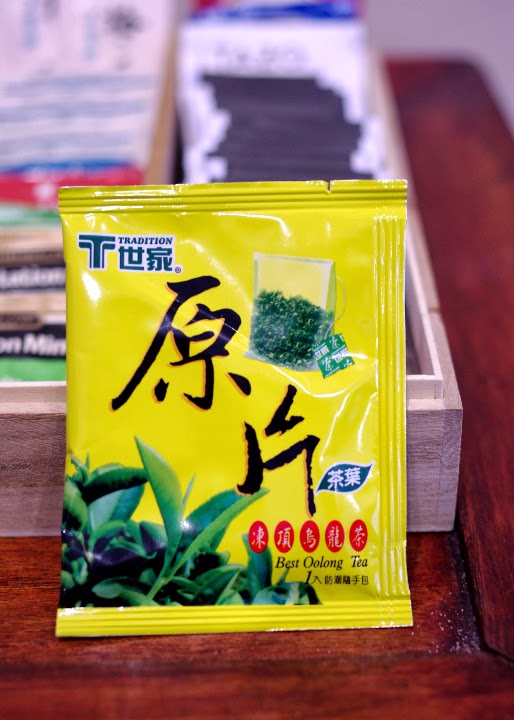
This Oolong teabag is actually made with whole leaves, as opposed to the broken, crushed, or sometimes dust leaves in regular tea bags.  It takes a while longer for the leaves to open, but it has solid flavors and can be steeped multiple times.  

This is Ume Konbucha, made from plum (ume), sea kelp (konbu), sugar and salt.  It's technically not a tea and is an acquired taste.  There are theories suggesting the trendy fermented sweet tea beverage "kombucha" got its name from konbucha due to the similarities between their sweet & sour flavor, or the appearance of the thick bacterial growth to sea kelp.

So, That's it for today.  Next time when you come to Peaceful Water, have a cup a tea!