Monday, March 31, 2014

Tasting Two Green Teas


Today, I am drinking two green teas I had for a while. Green teas are valued for their freshness, so neither of these two teas I am drinking are at the peak of their flavors.

The first one is named “Taiwan Native Green Tea” that I bought at the “Double Fire Brand Store” in Yingge, a northern Taiwanese town known for its pottery. Taiwan is very Oolong-centric. Majority of the tea was made into Oolong for domestic consumption. Only a small area of northern Taiwan produces green tea.

The dry leaves are dark green, irregular string-shape, some tips with white hair. Dry aroma is surprising sweet and toasty.


Steep...

... and turn!

I am using a competition / cupping style tea set, consist of a cup with handle and lid with a notch in the rim instead of pour spout, a bowl, and a dish.  

The liquor is clear pale yellow with very slight green tinge. The aroma is forest, seaweed, and cornhusk. The flavor is grassy and mineral. The mouthfeel is lingering and astringent, especially towards the back of the tongue and mouth. The returning sweetness is strong, reminiscent of honey and dry fruit. Overall impression is rustic and serious.


On to the next tea.

The second tea I am drinking is “Bilochun Green Tea” sold by Ten Fu’s Tea, that Kevin got as a gift. Bilochun is one of the best known Chinese green tea, originated in Jiansu province, especially around Lake Tai area, nicknamed “Fragrant Shock” for its intense aroma. However, this is not the real Bilochun. The description on the package called this a “Fujian Bilochun”, “using Fujian province’s fresh spring tea leaves, hand-made with unique Bilochun style process”.

The dry leaves are smaller, more uniform, with higher percentage of white hairy tips. Dry aroma is very floral.

The liquor is gold on the side of orange, with lots of surface chrystals. The aroma is cedar, cut grass and jasmine. The flavor is citrus and wood. The mouthfeel is less astringent, but slightly acidic. The returning sweetness is less strong, reminiscent of under-ripe strawberry. Overall impression is lively, feminine and slightly affected.


Looking at the steeped tea leaves afterwards, I am surprised that the Fujian Biluochun shows signs of oxidation: rusty-red edges. This kind of explains the fruitiness in the flavor. I don't really know if that is a common characteristic of Biluochun, or just a sign of careless tea processing.  Maybe I will investigate further.

Saturday, March 22, 2014

Different Types of Tea


At Peaceful Water, we like to offer people tea. We use tea bags for convenience but we have a good range from sencha to Oolong to Puerh.  A lot of people are curious to know more about tea, so I decide to write a bit about tea.

CAMILLIA SINESIS


I will first clarify. When I talk about “tea” here, I mean the dried leaves of the “tea plant” camillia sinesis. Rooibos, yerba mate, mint and chamomiles are perfectly good tisane or infusion. Only “tea plant” produces tea.

DIFFERENT TYPES OF TEA


Tea can be different because of different cultivars or different terroir (borrowing some wine terminology here...). But usually when we talk about different types of tea, we are talking about how tea is processed after it's picked. The moment a tea leaf is picked, it starts to go through enzymatic oxidation. In another word, it starts to wilt. Similar to when an apple is cut and left in contact with air, the apple will turn brown. The bright green tea leaf will wilt and turn brown. The enzymatic oxidation can be stopped at any point by applying heat.

If you don't let the tea oxidate at all, you will get green tea.

If you let the tea oxidate completely, you will get black tea (called “red” (紅) tea in Chinese for the color its liquor, to differentiate it from “black” (黑) tea, such as Puerh, which steep to a thick brown liquor, sometimes as dark of soy sauce!)

Anything in partially oxidated is green-blue (青) tea, best known as Oolong, usually roasted to some degree.

Post-fermented tea, best known as Puerh, is unoxidated or partially oxidated tea dried at low temperature, pressed into cake, then left to age in a warm humidified environment, until the tea undergoes microbial fermentation and further oxidation, transforming the flavor and mouthfeel of the tea. Or the aging process can be artificially sped up in an controlled environment before pressing the tea in to cake.

Less common variations are white and yellow tea. White tea is very lightly oxidated then dried. Yellow tea, is briefly fermented in an anaerobic environment before drying

TASTE OF TEA


When I was living in Toronto, tea had became fashionable and there were many tea shops. They usually carry hundreds of different blended and flavored tea. To sell their tea, they let you smell them. They usually smelled fabulous. Vanilla, spices, fruit peels, flower, ginger. (Notice how they never smelled like “tea”?) Drinking those teas were always disappointing. They usually taste flat and bland. As if people believe tea to be scented hot water and nothing more!

I do like to smell my tea. But I like my tea to have flavors too.

I believe that good tea should have depth of flavors that reveal itself in stages. First, the liquor hits your tongue. You might taste the vegetal, seaweed flavor in sencha; the honey, fruity tones in Darjeeling; or the floral quality in Anxi Tieguanyin. Then, the liquor travel through your mouth. You might feel the astringency of a Oolong; or the velvety mouth feel of a Puerh. Lastly, after the liquor had gone down your throat, a new wave of sweetness arise from the back of your throat. Jinxuan's creamy taste might yield to a sweetness reminiscent of sugarcane.


A good tea should give you all these stages, and maybe more.

CURRENT NOTABLE TEABAGS


Right now we have a couple interesting tea bags.

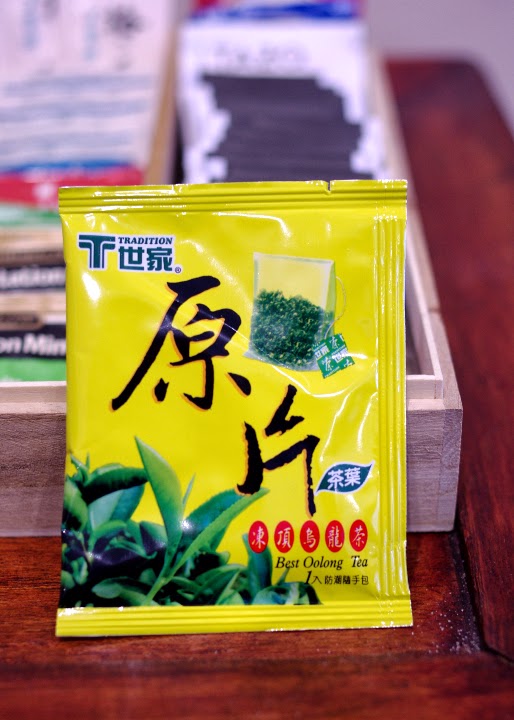
This Oolong teabag is actually made with whole leaves, as opposed to the broken, crushed, or sometimes dust leaves in regular tea bags.  It takes a while longer for the leaves to open, but it has solid flavors and can be steeped multiple times.  

This is Ume Konbucha, made from plum (ume), sea kelp (konbu), sugar and salt.  It's technically not a tea and is an acquired taste.  There are theories suggesting the trendy fermented sweet tea beverage "kombucha" got its name from konbucha due to the similarities between their sweet & sour flavor, or the appearance of the thick bacterial growth to sea kelp.

So, That's it for today.  Next time when you come to Peaceful Water, have a cup a tea!

Friday, March 14, 2014

Calligraphy - Cultivation of Character

We haven't been keeping up with the blog for a while.  I think it's good time to start it up again.

Earlier this year, I started to practice calligraphy again.  As a child in Taiwan, I had gone through the obligatory writing class, but never liked it.  I was known in my class and to my family for my ugly handwriting.  I'm surprised by how much I enjoy practicing calligraphy now.  There are infinite intricacies and variations in something so simple and formal.  It's like brewing beer strictly adhere to the Reinheitsgebot.  

I started to see calligraphy in many things.  Watching the Winter Olympic, I saw Virtue and Moir's ice dancing as moving ink strokes.  I saw in snowboarding the tip and edges of a brush.  When I practice Taiqiquan, I notice the similarity to the posture of the writer and the expression of the characters.  It's a black on white universe, where freedom exists in structure and everything is full of meaning.  

I find that in North America, calligraphy, whether the Chinese style done with a brush, or the Western style done with a nib, is considered as an art.  Often only people with artistic interests or inclination will approach it.  However, traditionally Chinese calligraphy was considered more as a cultivation of one's character.  Even though both painting and writing were done with the same style of brush on the same kind of paper with the same type ink, ancient calligraphers were rarely painters.  Instead, they were usually scholars, ministers, writers, even generals.  

I wonder if there are many people in North America who are intrigued by Chinese calligraphy but never bother trying it because they don't consider themselves artistic?  If anyone's interested in brush writing, we have a Chinese Calligraphy Study Group, every Monday night 7:45-8:45, at Peaceful Water Health & Fitness Lobby.  I am trying an approach so that no knowledge of the Chinese language is necessary.  However, it's inevitable anyone who write will eventually learn some Chinese.  For more info, please email: zoe@peacefulwaterhealth.com

Monday, July 29, 2013

Movement is Joy

I wasn't a very physical child. I was clumsy, slow, uncoordinated, and I disliked all team activities. My memory of gym classes are filled with frustrations, physical and emotional. I equate sports with rage and fear. I associate fitness with tedium and misery. In addition, my Taiwanese childhood was academically competitive and physical education was simply considered secondary. As a result, I grew up cerebral, detached from my own physical existence.
I was a stranger in my own body. I looked down on it as a collection of base instincts with nothing to offer. I resented my dependence on having a body. I struggled to rule over my body like a master driving her stubborn mule, and found it incompetent.
Obviously, this was not a good way to be, nor was it healthy or natural. It took me awhile to become ONE person. I am my body. My body is me. There is no struggle. There is nothing to struggle with.
It all started with the joy of movement.  
Impressed by Broadway musical, I took tap dancing lessons. Moved by the winter Olympic, I enrolled in ski camp. As I tapped across the dance floor and glided down the snowy slopes, I thought:  hmm...this...is...actually...FUN!
There is an innate pleasure in movements. Try this in the morning: wiggle your toes when you wake up in bed. Strangely, even the simplest movement tugged on something deep inside. It’s good to have toes. It’s good to move. It’s good to be alive.
Then I tried other things: tango, rock climbing, contact improv, taijiquan, systema. With each activity I learned, my competency grew, so did my confidence. But it wasn't just the better use of the body that kept me going. It wasn’t just the fun either. It was something deeper and simpler. It was to experience the world through my body. Some of you might say: umm, isn’t that called “living”?  
Let me explain what I mean. Different activities make me interact differently with my environment, with other people, with myself. My perception changes. My senses open. The line between body and mind ceases to be. Through movements I come to experience the world anew. Such is the joy of movement. And as such I would like to continue to move, to climb, to dance, to swim, to run, to live.
Maybe for me it is not about “Faster, Higher, Stronger”, or even “Be the best you can be.” Maybe it’s simply that “Movement is Joy”.

Thursday, July 25, 2013

Movement is Life

Movement is Life is the name of an event we will be participating in at the Buffalo Museum of Science on August 3rd.  The idea that "Movement is Life" actually resonates quite well with what we do at Peaceful Water Health and Fitness.  We offer clinical services of acupuncture and Chinese herbal medicine, and instruction in martial arts.  In Chinese medicine, many disorders of the body are due to a disruption of the normal substances in the body.  These basic substances of the body are the breath, the blood, the body fluids, the essence, and the spirit.  

Breathing and moving are two of the most essential activities we do.  Without them, nothing would function correctly, yet they are two things most people take completely for granted.  My experience of teaching people about breathing is that most people laugh when first presented with the prospect that breathing is something they have forgotten how to do correctly.  It is also surprising to people when you point out to them that they are often holding their breath.  This is a problem because breathing IS movement, and without it, smooth coordinated movement becomes harder.

I say breathing is movement because when we breath, it causes internal movement.  I don't mean internal movement in a metaphorical sense.  The whole body expands and contracts because of displacement caused by the lungs filling and emptying.  Without this, the blood inside the body would not be able to properly circulate.  The expanding and contracting causes a tug and release on the fascia  of the body as well.  When our psyche is in a calm state, and our body is relaxed we can feel this directly.  Any tension or fear in the psyche or in the body blocks our ability to feel this type of subtle movement.  We can learn to control this tension through our breathing, and we can learn to control our breathing by coordinating our physical movements with the breath.

In daily life, we constantly are exposed to things that create certain amounts of fear or tension.  It is important that we clean these things from ourselves regularly so that they are not given a chance to accumulate.  From the perspective of Chinese medicine, when emotional or physical stresses enter our body, they disrupt the normal circulation.  This disrupted circulation leads to accumulations, and these accumulations further block the circulation.  It creates a viscous cycle.  

By engaging in a healthy balance of rest and intelligent movement, we can help to clear these accumulations and clean out the stresses that are interrupting the normal physiological activity of the body.  When we coordinate this type of movement with breathing, it ultimately has a restorative and healing effect on the body and mind.  

Sunday, June 16, 2013

This is the first post for peaceful water health and fitness.  We are a health and wellness center in Western New York specializing in Chinese medicine.  Our services include acupuncture, Chinese herbal medicine, and instruction in the martial art of Taijiquan.

You can visit us on the web at www.peacefulwaterhealth.com

We hope to use this blog to inform the public about Chinese herbal medicine and Acupuncture therapies, as well as the benefits of studying martial arts such as Taijiquan.